
Thème : École
Soutenance de thèse de Jinlin JIANG
Résumé de la thèse en français
Fluid injections related to the exploitation of geothermal reservoirs often lead to the reactivation of faults, in the form of a slow or seismic slide, triggering in turn so-called induced earthquakes. This thesis is devoted to a numerical study of seismic slip triggered by fluid injection. A FEM model is developed to simulate injection experiments carried out in a triaxial press. The simulations presented in this work make it possible to quantify the effect of the injection scenario, the diffusivity of the fault, the frictional properties and the initial stress state on the expansion dynamics of seismic slip, providing a new look at the laws of scale characterizing the fracture velocity and the maximum moment released. The approach presented provides avenues for reflection to improve the assessment of the hazard related to geothermal exploitation. The numerical model developed is also validated on an experimental dataset, which opens up important perspectives for deepening the mechanical interpretation of injection experiments conducted in the laboratory.
Résumé de la thèse en anglais
Fluid injections performed in the framework of geothermal exploitation can reactivate slip on preexisting crustal faults, leading to aseismic slip transients in turn triggering so-called triggered earthquakes. This PhD thesis is a numerical study dedicated to the physical control on the fluid-induced aseismic slip. A hydromechanical FEM is developed to simulate injection experiments performed in a tri-axial cell in the laboratory. The simulations presented allow to quantify the effect of the injection scenario, the hydraulic diffusivity, the fault friction and pre-stress on the dynamics of induced aseismic slip, providing new insights into the scaling laws commonly used to characterize this phenomenon, in particular the rupture speed and the maximum moment released. The approach presented here is thus of importance in the perspective of improving hazard mitigation in the context of geothermal exploitation. The model predictions are also validated on a real experimental dataset, which opens a new avenue to improve the mechanical interpretation of injection experiments in the laboratory.
 En savoir plus
Soutenance de thèse de Lucia CLAROTTO
Résumé de la thèse en français
L'introduction de modèles statistiques inspirés de la physique des phénomènes sous-jacents et numériquement efficaces est d'un intérêt croissant pour la prédiction de processus spatio-temporels en sciences environnementales. Les grands jeux de données spatio-temporelles nécessitent de nouvelles méthodes numériques efficaces. L'approche par Equations aux Dérivées Partielles Stochastiques (EDPS) s'est avérée efficace pour l'estimation et la prédiction dans un contexte spatial. Nous présentons ici une EDPS d'advection-diffusion avec une dérivée de premier ordre en temps qui définit une grande classe de modèles spatio-temporels non séparables. On construit une approximation de la solution de l'EDPS par un champ aléatoire Markovien Gaussien en discrétisant la dérivée temporelle par la méthode des différences finies (Euler implicite) et en résolvant l'EDPS spatiale par la méthode des éléments finis (Galerkin continu) à chaque pas de temps. La technique de stabilisation "Streamline Diffusion" est introduite lorsque le terme d'advection domine la diffusion. Des méthodes de calcul efficaces sont proposées pour estimer les paramètres de l'EDPS et pour prédire le champ spatio-temporel par krigeage, ainsi que pour effectuer des simulations conditionnelles. L'approche est appliquée à des jeux de données de rayonnement solaire et de vitesse du vent. Ses avantages et ses limites sont examinées, et de nouvelles perspectives de travail sont envisagées, notamment afin de proposer une extension dans un cadre non stationnaire. On présente également un travail portant sur la généralisation non séparable de la classe de Gneiting des fonctions de covariance spatio-temporelles multivariées. Le principal potentiel de l'approche est la possibilité d'obtenir des modèles entièrement non séparables dans un cadre multivarié, et les avantages sont illustrés sur un ensemble de données météorologiques trivariées. De plus, on propose une analyse de méthodes d'estimation et de prédiction approximées pour les données spatiales et spatio-temporelles, motivée par l'objectif de parvenir à un compromis entre l'efficacité statistique et la complexité computationnelle. Ces méthodes se sont avérées efficaces pour l'estimation des paramètres et la prédiction dans le contexte de la "Compétition de statistiques spatiales pour les grands jeux de données" organisée par la King Abdullah University of Science and Technology (KAUST) en 2021 et 2022. Enfin, d'autres pistes de recherche sont envisagées et examinées.
Résumé de la thèse en anglais
In the task of predicting spatio-temporal fields in environmental science using statistical methods, introducing statistical models inspired by the physics of the underlying phenomena that are numerically efficient is of growing interest. Large space-time datasets call for new numerical methods to efficiently process them. The Stochastic Partial Differential Equation (SPDE) approach has proven to be effective for the estimation and the prediction in a spatial context. We present here the unsteady advection-diffusion SPDE which defines a large class of nonseparable spatio-temporal models. A Gaussian Markov random field approximation of the solution to the SPDE is built by discretizing the temporal derivative with a finite difference method (implicit Euler) and by solving the spatial SPDE with a finite element method (continuous Galerkin) at each time step. The Streamline Diffusion stabilization technique is introduced when the advection term dominates the diffusion. Computationally efficient methods are proposed to estimate the parameters of the SPDE and to predict the spatio-temporal field by kriging, as well as to perform conditional simulations. The approach is applied to solar radiation and wind speed datasets. Its advantages and limitations are discussed, and new perspectives for future work are envisaged, especially involving a nonstationary extension of the approach. As a further contribution of the PhD, the nonseparable generalization of the Gneiting class of multivariate space-time covariance functions is presented. The main potential of the approach is the possibility to obtain entirely nonseparable models in a multivariate setting, and this advantage is shown on a weather trivariate dataset. Finally, a review of some methods for approximate estimation and prediction for spatial and spatio-temporal data is proposed, motivated by the objective of reaching a trade-off between statistical efficiency and computational complexity. These methods proved to be effective for parameter estimation and prediction in the context of the "Spatial Statistics Competition for Large Datasets" organized by the King Abdullah University of Science and Technology (KAUST) in 2021 and 2022. Lastly, possible further research directions are discussed.
En savoir plus
Soutenance d’HDR de Christine Franke
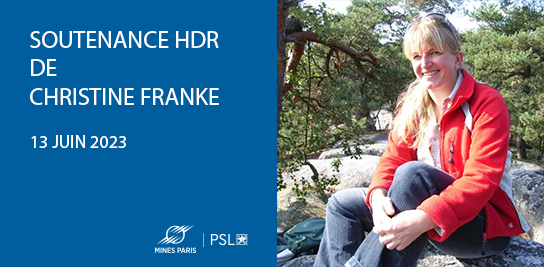
Christine Francke, enseignante-chercheuse au centre de Géosciences Mines Paris – PSL, soutiendra son habilitation à diriger des recherches (HDR) "Traçage physico-chimique des particules et application des paramètres poxy magnétiques à des environnements marines et continentaux"
Devant un jury composé de :
Mme France LAGROIX, Institut de Physique du Globe de Paris, Paris (présidente du jury)
Mme Diana JORDANOVA, National Institute of Geophysics, Geodesy and Geography, Bulgarian Academy of Sciences, Sofia (rapportrice)
M. Leonardo SAGNOTTI, Istituto Nazionale di Geofisica e Vulcanologia, Rome (rapporteur)
M. Yohan GUYODO, Institut de Physique du Globe de Paris, Paris (rapporteur)
Mme Elodie GUIGON, Ecole Pratique des Hautes Etudes, Sorbonne Université, Paris, (examinatrice)
M. Olivier CERDAN, Bureau de Recherches Géologiques et Minières, Orléans (examinateur)
M. Olivier EVRARD, Laboratoire des Sciences du Climat et de l'Environnement, Gif-sur-Yvette (examinateur)
M. Mark DEKKERS, Utrecht University, The Netherlands (invité)
M. Tilo VON DOBENECK, University of Bremen, Germany, (invité)
Lieu : Institut de Physique du Globe de Paris, 1 rue Jussieu, Paris 5e (à 14h en salle 310)
Il est possible de participer par visio zoom.
- Résumé en anglais en pièce jointe.
Contact : Isabelle Thénevin
L’impact de la recherche publique sur la R&D des entreprises
Une enquête nationale de Mines Paris - PSL, avec le soutien de l’Association Nationale Recherche Technologie et de l’Académie des Technologies

PROGRAMME PROVISOIRE
10h15 : Accueil sur place et ouverture de la connexion
10h30 – 12h30 : Présentation de l’enquête et échange avec les différentes parties prenantes
Introduction : Vincent Laflèche (Directeur Général, Mines Paris PSL) et Clarisse Angelier (Déléguée Générale, ANRT)
Keynote : Pierre-Louis Autin (Chef du service – Innovation, transfert de technologie, action régionale, DGRI)
Présentation des résultats de l’étude : Phuong Hoang, Valérie Archambault et Matthieu Glachant (Mines Paris PSL)
Table ronde animée par Pierre Bitard (ANRT), avec Pierre-Louis Autin (DGRI-SITTAR), Sophie Rémont (BPI), Vincent Garnier (Safran), Jean-Michel Dalle (Agoranov), Laurent Billet (EDF) et Yassine Lakhnech (Université Grenoble Alpes)
Échange avec le public
Conclusion
12h30 : Buffet déjeunatoire
Lieu : Mines Paris – PSL, 60 boulevard Saint-Michel – Paris
et sur zoom (de 10h15 à 12h30)