
EGU 2026 Call for Abstract
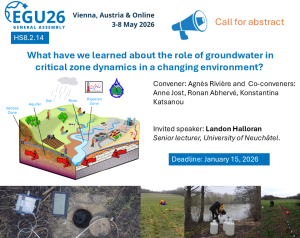
Call for abstract
Le 15 January 2026
Dear colleagues,
As the year comes to an end and the winter holidays draw near, we would like to convey our sincere wishes for a restful break and a successful year ahead. May the coming months be marked by fruitful research, stimulating collaborations, and new scientific achievements.
We are pleased to invite you to contribute to our session,
“What have we learned about the role of groundwater in critical zone dynamics in a changing environment?”
at the EGU General Assembly 2026,
taking place in Vienna and online from 3–8 May 2026.
We’re also delighted to share that Landon Halloran, Senior Lecturer at the University of Neuchâtel, will be joining us as our invited speaker.
The deadline to submit your abstracts is January 15, 2026. Please be sure to follow the instructions provided via the Abstract submission link.
We kindly ask you to share this session with anyone who might be interested.
We look forward to your contributions and to meeting you in Vienna!
Best regards,
Agnès Rivière, Anne Jost, Ronan Abhervé & Konstantina Katsanou
Agnès Rivière, Anne Jost, Ronan Abhervé & Konstantina Katsanou
Groundwater’s strategic importance for ecosystems (biodiversity, and societies) is gaining prominence. Groundwaters play a critical role in natural cycles, redistributing water, energy and matters in the subsurface and sustaining surface water bodies and ensuring related biodiversity. Overall groundwater is key for continental areas, by providing essential ecosystem services hence ensuring water, energy, and food security.
Groundwater dynamics significantly impact ecosystems. Non stationarity of groundwater systems dynamics under global changes put these ecosystems at threat. Therefore, it is key to characterize these ecosystem-groundwater interrelationships by studying the quantitative and qualitative impacts of ecosystems on groundwater resources through a wide range of tools such as characterizing the transit and residence time of water and elements in groundwater systems, the vegetation-atmosphere-unsaturated zone interactions with the aquifers enabling to quantify in aquifer recharge and stream-aquifer exchanges.
To do that hydrogeological models are pivotal tools to characterise and anticipate potential change of these relationships between ecosystems and groundwater. However, due to the extreme heterogeneity of environmental processes and parameters, and our inability to fully characterise that heterogeneity, all hydrogeological models need to be calibrated against relevant geological, geophysical, hydrogeochemical and hydrological data to improve the robustness of predictions and reduce model uncertainty. Observatories provide long-term, spatially detailed information on groundwater resources, enabling in-depth studies, that consider the interplay of territorial changes together with climate change. These observatories therefore provide the opportunity to identify key processes driving these changes, occurring at the local or regional scales. Installed in heterogeneous environments, observatories consider different aquifer types at different geographical areas and reflect the interplay between land uses, climate zones, and human pressures on the dynamics of groundwater resources in ecosystems changing.
Groundwater dynamics significantly impact ecosystems. Non stationarity of groundwater systems dynamics under global changes put these ecosystems at threat. Therefore, it is key to characterize these ecosystem-groundwater interrelationships by studying the quantitative and qualitative impacts of ecosystems on groundwater resources through a wide range of tools such as characterizing the transit and residence time of water and elements in groundwater systems, the vegetation-atmosphere-unsaturated zone interactions with the aquifers enabling to quantify in aquifer recharge and stream-aquifer exchanges.
To do that hydrogeological models are pivotal tools to characterise and anticipate potential change of these relationships between ecosystems and groundwater. However, due to the extreme heterogeneity of environmental processes and parameters, and our inability to fully characterise that heterogeneity, all hydrogeological models need to be calibrated against relevant geological, geophysical, hydrogeochemical and hydrological data to improve the robustness of predictions and reduce model uncertainty. Observatories provide long-term, spatially detailed information on groundwater resources, enabling in-depth studies, that consider the interplay of territorial changes together with climate change. These observatories therefore provide the opportunity to identify key processes driving these changes, occurring at the local or regional scales. Installed in heterogeneous environments, observatories consider different aquifer types at different geographical areas and reflect the interplay between land uses, climate zones, and human pressures on the dynamics of groundwater resources in ecosystems changing.
This session seeks to highlight innovative approaches that integrate field data with advanced modelling techniques to deepen the understanding of complex hydrological, hydrogeological, and ecohydrological systems under the impact of global change.
Solicited authors:
Landon Halloran
Landon Halloran
 En savoir plus
